What the My Type FYI test actually does
Most “what's my type” quizzes ask you to describe the kind of person you are drawn to in words. That sounds precise and is not. People have poor access to their own preferences, and the vocabulary is shared — almost everyone says kind, funny, good energy. You end up with a label that fits half the room.
The My Type FYI test replaces the description with a choice. Twelve AI-generated faces appear, you tap the ones you would stop for, and a new face fills each slot as you go. Six rounds add up to more than seventy different faces, and more if you tap a lot. Every tap is a positive signal; every face you saw and skipped is a negative one. The pattern across those choices is the result.
Under the hood it is a small preference model trained in your browser:
- Each face carries ten tags — gender presentation, age range, skin tone, hair colour, hair length and texture, distinctive feature, brow weight, facial hair, lip fullness and eye openness.
- Your taps and skips become labels, and a regularised logistic regression learns which tags you consistently lean toward.
- Once there are enough taps to draw a line, rounds five and six are chosen adaptively: the test shows faces near your current decision boundary to sharpen the estimate instead of repeating what it already knows.
90 seconds, against about ten minutes
The original mytype.fyi is a longer test: about twenty crowds of twelve faces, which it puts at roughly ten minutes. You can tap as many faces as you like there, and each one you touch is replaced, so it is not a single choice. What differs is the ending. When the result is ready, the page asks for an email address, or a Google or X account, before it will show you the card.
Here the whole run is six rounds, about ninety seconds, and the result appears on the same screen with nothing asked for. That is not a moral position. For a test this short, a login is longer than the thing it guards: about a minute on a desktop, and considerably more on a phone, where it means leaving the page, finding a password, coming back to a tab that has reloaded, and starting again.
So there is nothing between the page and the first face. No account, no email capture, no “continue with”. Your taps are processed in the browser while you take the test, so there is nothing to attach to an identity in the first place.
Ten minutes of tapping and then a form is a different product from ninety seconds and a card you can send. We picked the second one, and the shorter run is what made dropping the gate affordable.
How six rounds find a pattern
Twelve faces appear. You tap the ones you would stop for, and a fresh face takes each slot you touched. Nothing else is asked: no adjectives, no scale, no rate it one to ten.
The first four rounds are built to cover ground. Each grid is assembled so that no single trait dominates it, so you see fair skin beside deep, thick brows beside thin, short hair beside long. Those four rounds produce the first rough estimate of where your attention goes.
Rounds five and six change job. Once there is a rough line between the faces you tap and the faces you skip, showing you more of the same tells us almost nothing. So those rounds are filled towards the line itself, with faces that sit close to it plus a few pulled toward what you have been tapping. That is where the estimate gets sharper instead of merely being repeated.
Skipping all twelve is a valid answer. A skip is a real judgement, not missing data.
What your result card looks like
A My Type FYI result card has three parts, and they answer different questions.
The headline is your type, written as the three traits that moved your choices most: a length and texture, an age range, and a hair colour — “Long straight · 30s · Red” is one shape it takes. It is descriptive. There is no eight out of ten, because the test measures what you like, not what you are worth.
Below the headline are the faces most visitors tap and you walked past. That gap is usually the most surprising line on the card, and the reason people send it to someone.
The third part runs the other way. Hidden gems are faces that sit in the middle of the crowd's ranking but high in yours: the ones you would have missed if you only looked at someone else's list.
The card also reports how selective you were, as the share of faces you actually tapped. Tapping four in a hundred is a real answer. So is tapping forty. Neither one is the correct answer.
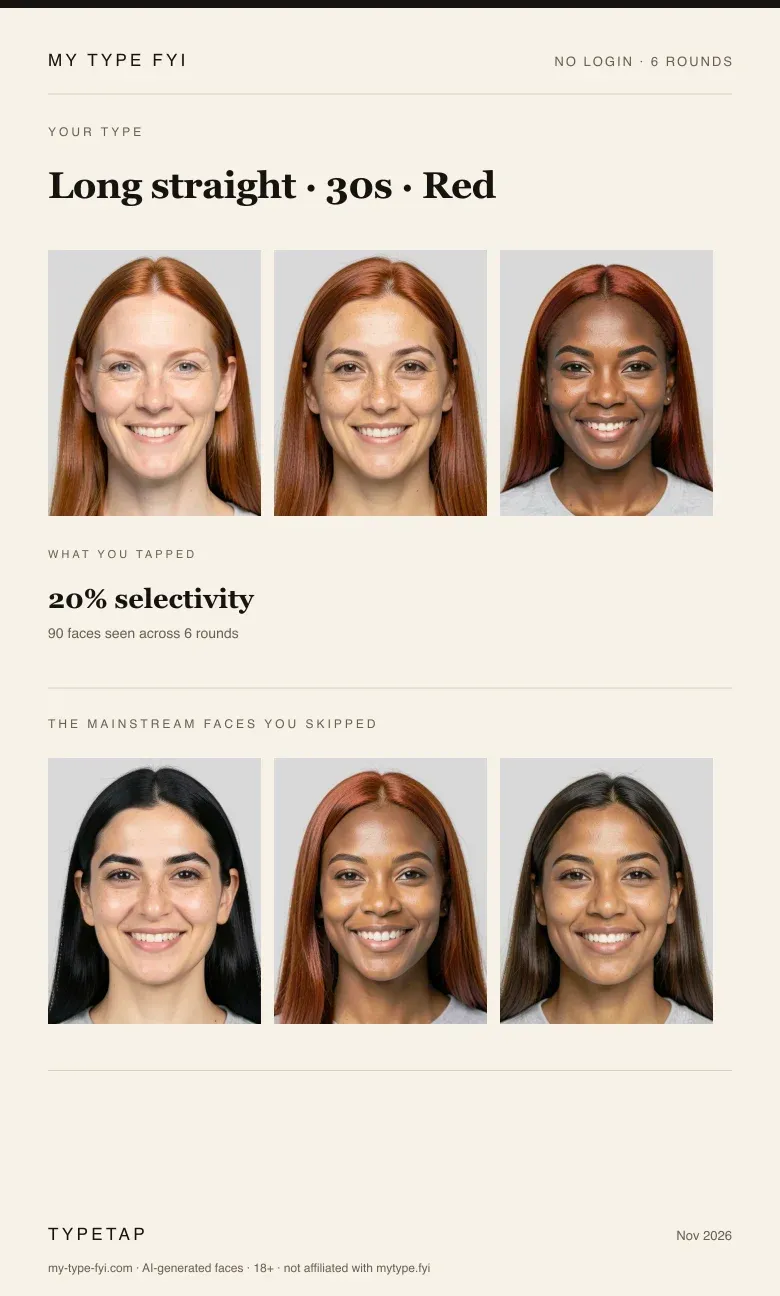
One note on the numbers. The “most people tap” line comes from crowd data, and while there is not enough of it the wording stays deliberately vague instead of printing a percentage we cannot back. If you want the longer explanation of what “type” means and why word-based quizzes keep missing it, read what is my type.
Hidden gems, and the faces you skipped
Two people can both take the My Type FYI test and end up with cards that disagree on almost every face, because the useful signal is in the disagreement, not the agreement.
A face the crowd taps that you skipped is a place you are genuinely outside the norm. A face in the middle of the crowd's ranking that you tapped is a hidden gem: not the room's favourite, but yours. The card lists three of each.
This is the part people screenshot. A type name on its own is a horoscope. A type name plus the specific faces everyone else picked and you did not is a claim about your taste that a friend can argue with, which is a much better thing to send someone.
We do not put a percentage on how rare your taste is. The pool is 181 faces and the crowd data is still thin, so any line about your top three percent would be invented. What the card shows is your position against the faces you were actually shown.
Is this the same as mytype.fyi?
No. mytype.fyi is the original, made by My Type FYI LLC, and it is a good product: it is the reason this category exists at all. TypeTap is an independent implementation, with our own face pool, our own question set and our own result format. We are not affiliated with it.
What we share is the premise. Asking people to describe their type in words does not work, so ask them to tap faces instead.
If you want the original, it is at mytype.fyi. If you want the comparison — rounds, account, face pool and what the card actually shows — it is on one page: MyType alternative: what is different.
My Type FYI test FAQ
Is this the same as mytype.fyi?
No. mytype.fyi is the original, made by My Type FYI LLC, and TypeTap is an independent implementation with its own face pool and result format. We are not affiliated with it — the full comparison is on the MyType alternative page.
Do I need an account to take the My Type FYI test?
No. There is no signup, no email and no login. The faces load, you tap, and the result appears on the same screen.
How long does the My Type FYI test take?
About 90 seconds. Six rounds of twelve faces, with a new face filling each slot as you tap. You can stop a round early at any time; skipping every face in a round is also a valid answer.
Are the faces real people?
No. Every face is AI-generated for this test. We do not use photos of real people, public figures or anything scraped from another site.
Is my result private?
Your preference is computed in your browser and your taps are never uploaded. Progress is saved in your own browser so a reload does not lose a half-finished run; that copy stays on your device. What we do record is anonymous page events — no cookies and no IP addresses. A result is only stored on our side if you explicitly create a share link, and even then it holds face ids, a type name and the faces you tapped. The privacy page lists exactly what is stored.
Can I take it again?
Yes. Each run draws a fresh grid, so a second run is a second measurement rather than a re-read of the first. A slightly different card is normal.
The My Type FYI test is at the top of this page, and it does not need anything from you first. Take the face test.